
Megalopolis.
It calls itself a fable. But brilliant filmmakers are only fabulists in one specific sense.

I watched Megalopolis last Sunday.
Francis Ford Coppola's magnum opus.
I'm sure other critics have hundreds of things to say. About how it's substanceless or confused or hackneyed or brilliant. Personally, I thought it was a work of art and, while boring at times, completely worth watching. That's not what I really care about.
At the climax of the movie, our Byronic protagonist Cesar Catalina, played by Adam Driver, gives a long speech/monologue. It is an "uplifting", soulful invocation of the strength of the human spirit and the powerful love and the need to hope for a better future that feels transparently like a monologue that Francis Ford Coppola would like to give us, the audience. These words are the wisdom of an old man, projected through a young and charismatic one. The auteur, idealized.
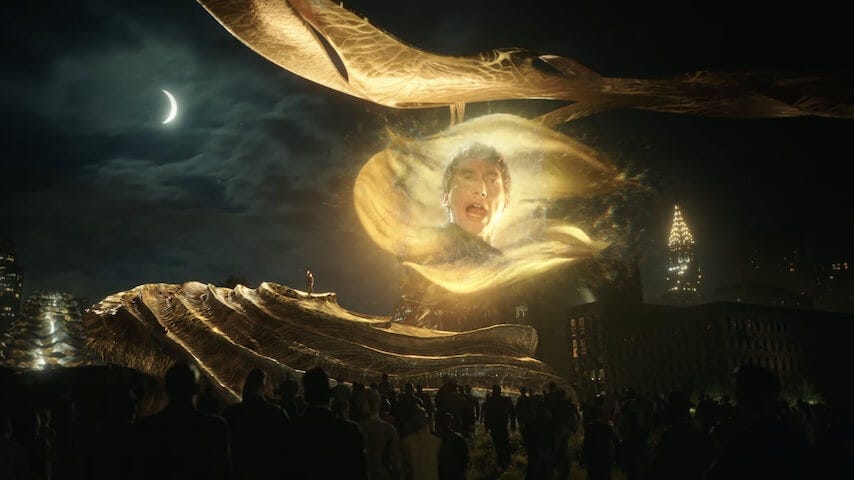
I don't remember the full details of the monologue. He just goes on and on about the power of love and the need for philosophy, and I think the power of consciousness also appears somewhere in there as well. It's pseudoprofound, pseudoscientific rambling that somehow stirs the heart of the crowd and opens the doors to the shining city on the hill that is the titular Megalopolis.
I mean, I think it's pseudoprofound and pseudoscientific. It could actually be very profound and very scientific on a metaphorical level I am simply too stupid to understand.
The movie beats us over the head with its metaphors, though. The main plot transposes quite a lot of the political ascent of Julius Caesar into modern day America. So for it to turn around and ultimately juxtapose one message, that "Visions of a glorious utopia of the future are good and should be encouraged" when the visionary is a pastiche of the man who ended the Roman Republic and created the Roman Empire, with another message of "Donald Trump's populism is bad" down to a Mussolini-like hanging of the stand-in character (who, at some point, might also make some Gamestop references? Unclear), is certainly an interesting artistic choice.
And yet it all seems to sputter out with that discussion of consciousness and the overcoming power of the human spirit, so long as it's wielded by the *right* people.
Sir Roger Penrose: Brilliant Physicist

I had the pleasure of hearing Sir Roger Penrose speak a while ago.
Roger Penrose was, in his younger years, an extremely brilliant physicist. He worked out the complex and arcane math governing black holes, as well as many other foundational concepts in cosmology.
When I saw him speak, he was entertaining a theory about how quantum vibrations in microtubules in the brain were ultimately responsible for consciousness. A theory with little other mainstream support.
Now, don't get me wrong. Knowing the math to understand cosmology is quite close -- at least compared to not knowing math at all, and working out the secrets of the universe through "feeling" and "thinking hard enough" -- to knowing the math necessary to understand quantum physics. I have no doubt that Sir Roger Penrose was fully qualified to understand quantum physics. But it wasn't what he made his name on, it wasn't what catapulted him to prestige, and it certainly wasn't what he got his 2020 Nobel Prize in Physics for.
Those were all for the black holes.
But once he'd gotten this prestige, and become intelligent and wise and an authority, his mind turned to the deep questions that plague us all. Who we are. Where we come from. How we're able to think.
And that brought him and his undeniably, unmistakable domain mastery of black-hole math into a realm where he was as in the dark as all the rest.
And this isn't a rare case. It happens a lot to physicists, or other domain knowledge experts. Even football players. Given their vast successes and prowess over one aspect of the world, they get asked about their opinion about all the rest, of which they are untrained tyros as much as the common man. The Halo Effect.
That, I think, is roughly how I feel about the messages of Megalopolis.
It's Coppola's magnum opus. The Great Work. The Great Work, of a brilliant filmmaker.
This is the man who brought the Godfather to life, to critical acclaim. Who made Apocalypse Now. His mastery of filmmaking as a medium is undeniable.
And yet, tragically, his ability to raise a mirror to our times is as limited as everyone else's.